

Domain Migration SEO: The Complete Guide to Moving Without Losing Everything You’ve Built
A domain migration is one of the most consequential technical events a website can go through. Done correctly, it preserves years of built-up search authority and delivers users to the right destination without friction. Done poorly, a domain migration can wipe out organic visibility for months, or permanently. This guide covers everything from the strategic decision to move, through execution, to post-migration recovery, and the critical use-case scenarios most guides never address.
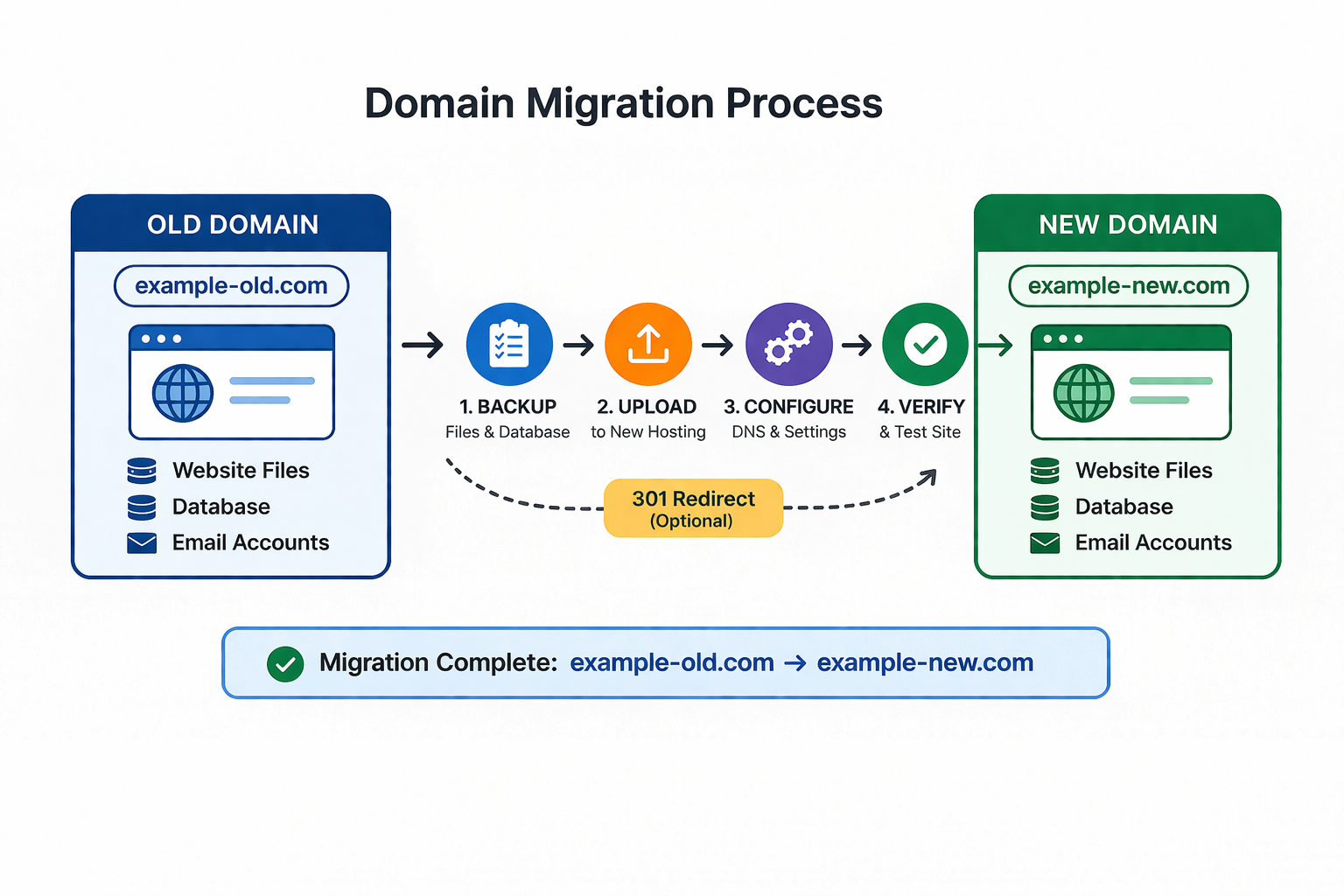
Why Businesses Change Domains, and Why a Domain Migration Is Always Riskier Than It Looks
The reasons businesses undergo a domain migration are varied: a rebrand, website redesign, an acquisition, a market pivot, or simply shedding a domain name that no longer reflects what the business does. Whatever the trigger, the decision to migrate to a new domain is rarely taken lightly, and it shouldn’t be. Google has spent years learning the signals associated with your current domain: the links pointing to it, the content it hosts, the queries it satisfies, and how users interact with it. A domain migration means asking Google to transfer that institutional knowledge to somewhere entirely new.
The uncomfortable reality is that Google doesn’t do this seamlessly. There is always a period of ranking volatility during a site migration, always a risk of organic traffic loss, and always the possibility that some of the search authority you’ve built doesn’t survive the transition. The question isn’t whether there will be an impact, there will be. The question is how to minimise it, and how quickly you can recover your crawl budget efficiency, link equity, and keyword rankings on the new domain.
At New Perspective Design, we’ve guided businesses through domain migrations and site migrations of varying complexity, from straightforward rebrands to technically demanding consolidations involving hundreds of URLs. The pattern is consistent: the businesses that navigate domain migration SEO successfully are the ones that treat it as a months-long project, not a one-day technical task.
When you execute a domain migration, Google must re-evaluate and re-attribute the authority, relevance, and trust signals it had previously assigned to your old domain. This process is not instantaneous. Rankings will fluctuate. Organic traffic may drop significantly. Recovery timelines depend on how well the domain migration is executed, the size of the site, the strength of your backlink profile, and how aggressively Google decides to recrawl.
The Standard Domain Migration Approach, and Why It Works
For the majority of businesses with healthy domains and no underlying issues, the playbook for a domain migration is well-established. The standard site migration process follows a logical sequence that gives Google everything it needs to connect the old domain to the new one and begin reassigning link equity and ranking signals.
Pre-Migration: The Foundation Work
Before a single 301 redirect is configured or a single page goes live on the new domain, there is significant preparation required. This pre-migration phase is where most domain migrations are won or lost, and where New Perspective Design spends considerable time with clients before any technical work begins.
- Conduct a complete URL inventory of the current domain, every page, not just the top organic performers.
- Pull a full backlink profile audit to understand which pages carry the most inbound link equity and referring domain authority.
- Identify the top organic traffic pages using Google Search Console and GA4 data, these are your highest-risk assets during the migration.
- Benchmark current rankings, indexed page counts, crawl coverage, and organic traffic as your baseline for measuring domain migration recovery.
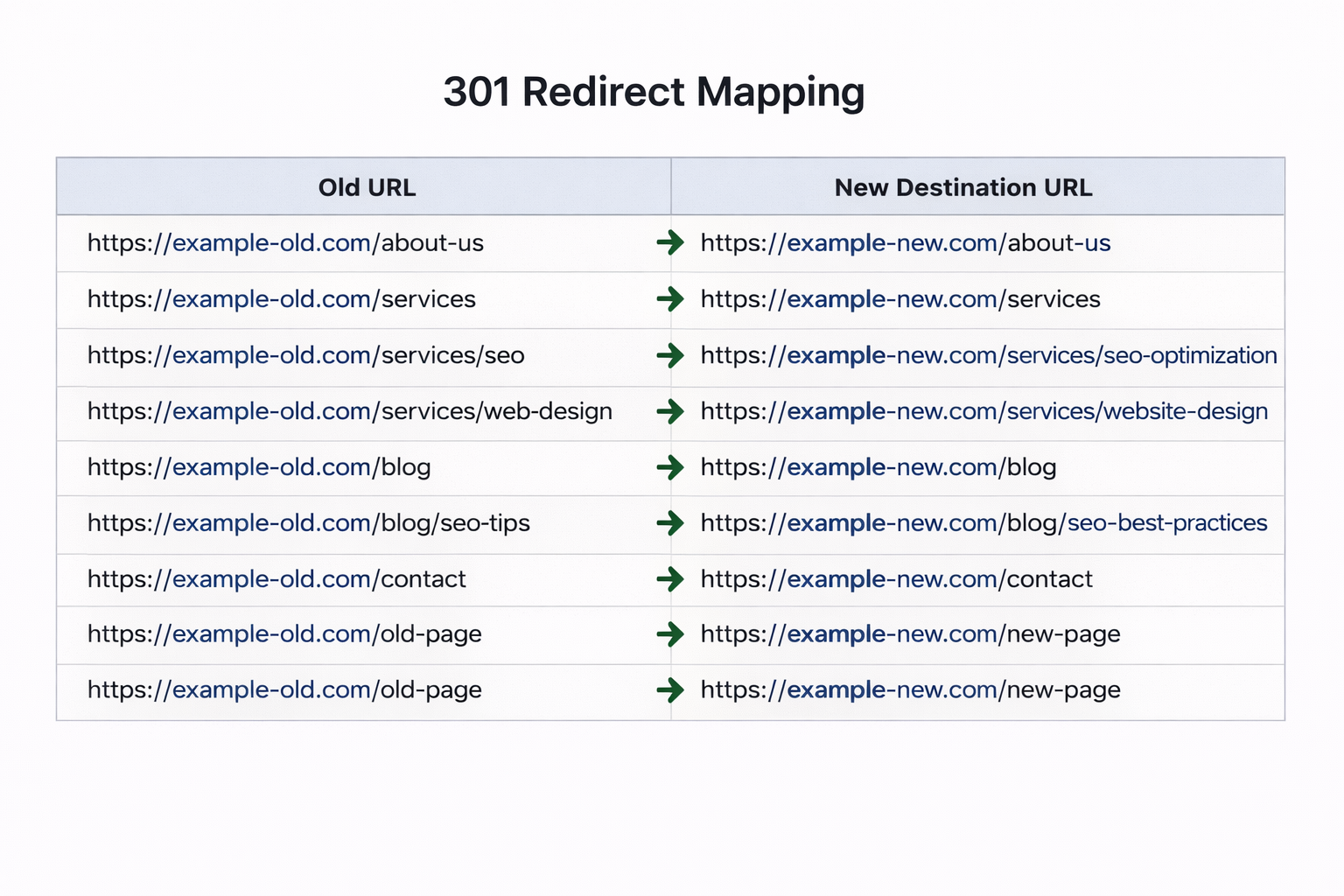
- Create a 1:1 URL mapping document, every old URL matched to its exact equivalent on the new domain.
- Decide what happens to pages that won’t carry across: consolidation targets, removal candidates, or pages that will return a 404.
- Set up Google Search Console for the new domain before launch so indexing data begins accumulating from day one.
Redirect Strategy: The Most Critical Step in Any Site Migration
Every URL on the old domain must return a 301 redirect to its equivalent on the new domain. Not a 302, a 301 signals a permanent move and passes link equity through to the destination. This is non-negotiable for preserving the search authority built on the old domain during a domain migration.
Redirect chains must be eliminated before the migration goes live. A redirect chain, where URL A redirects to URL B which then redirects to URL C, dilutes link equity at each hop and slows down crawling, eroding the crawl budget efficiency Google allocates to your new domain. Every old URL should redirect directly to its new equivalent in a single hop.
Internal links on the new domain should point to new URLs directly rather than relying on the redirect chain. While 301 redirects preserve link equity between domains, direct internal links are significantly stronger signals and support faster reindexing during the domain migration recovery period.
- All redirects must be 301 (permanent), not 302 (temporary), this is fundamental to preserving link equity in a domain migration.
- No redirect chains or loops, every old URL must resolve to its new equivalent in a single step.
- Dynamic URLs, filtered pages, faceted navigation, and URL parameters must all be accounted for in the redirect map.
- Canonical tags on the new domain must reference new domain URLs only.
- Update XML sitemaps to reflect the new domain structure and submit immediately via Search Console post-launch.
- Review and update robots.txt on the new domain to ensure no pages are inadvertently blocked from crawling.
- Use the Change of Address tool in Google Search Console to formally notify Google of the domain migration.
Redirecting every URL to the homepage is the single most damaging redirect error made during a site migration. It destroys the page-level signals Google had built for individual URLs and effectively signals that all that content no longer exists. In a domain migration, every redirected URL must land on the most contextually relevant equivalent page on the new domain.
Technical Integrity Checks During a Domain Migration
Redirects are necessary but not sufficient for a successful domain migration. There is a longer checklist of technical elements that must be verified before and after launch to ensure the site migration holds up under Google’s crawl.
Must Be Updated
- All internal links across the site
- Structured data and schema markup references
- Image and asset source URLs
- Hreflang tags (if applicable)
- GA4 and Google Tag Manager configuration
- Conversion events and goal tracking
- Google Ads destination URLs
Must Be Verified Post-Launch
- Crawl errors and 404s in Search Console
- Redirect response codes via crawler
- Indexing status of new domain pages
- Core Web Vitals on new domain
- Traffic continuity in GA4 analytics
- Ranking stability week-over-week
- Outreach to key link partners to update
What to Expect After a Domain Migration Goes Live
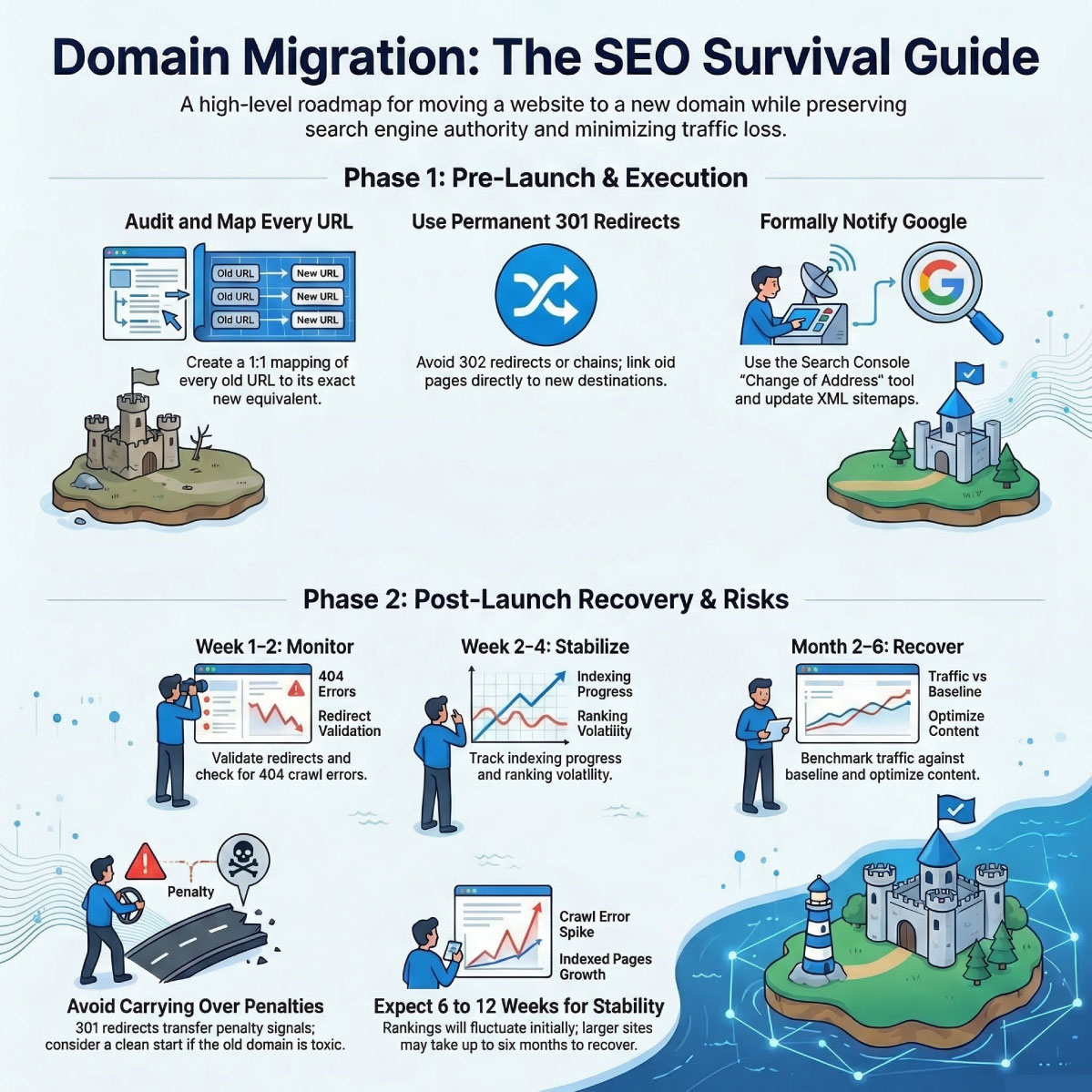
Even a perfectly executed domain migration will produce some ranking volatility. Google needs time to discover the redirects, crawl the new domain, process the Change of Address notification, and reassign the ranking signals it had associated with the old domain. In the first two to four weeks after a site migration, rankings may fluctuate significantly, some pages may temporarily disappear from results before returning as indexing consolidates.
Domain migration recovery timelines vary considerably depending on site size, crawl budget, domain age, backlink profile quality, and how thoroughly the migration was executed. Small to medium sites with clean redirect structures typically stabilise within six to twelve weeks. Larger or more complex site migrations may take four to six months before rankings and organic traffic fully return to pre-migration baselines.
The Scenario That Changes Everything: What If Your Old Domain Has a Penalty?
The standard domain migration playbook is built around one assumption: that your old domain is healthy. But what happens when it isn’t? This is the domain migration use case that most guides gloss over, and it’s where the consequences of getting the strategy wrong are most severe.
A domain carrying a Google penalty, whether a manual action for unnatural links, thin content, or algorithmic suppression from a Helpful Content update or broad core update, presents a fundamentally different site migration challenge. In this scenario, the conventional redirect-everything approach may actively work against you.
When you set up 301 redirects from a penalised domain to a new one, you are not just passing link equity, you are also passing association. Google’s systems are sophisticated enough to recognise that the new domain is the successor to the old one. In cases where the old domain has significant algorithmic or manual trust issues, this association can suppress the new domain’s ability to rank even before the site migration gets off the ground. New Perspective Design always recommends a thorough domain health audit before any redirect strategy is finalised, this single step can fundamentally change the approach.
Identifying Whether Your Domain Has a Penalty Before Migration
Before deciding on a domain migration strategy, you need to know what you’re actually dealing with. A Google penalty is not always obvious, and the type of penalty matters enormously for how you structure the site migration.
- Check Google Search Console for any active manual actions under the Security and Manual Actions section, this is the clearest signal of a formal Google penalty.
- Review your organic traffic history for sudden, sustained drops that correlate with known Google algorithm update dates, core updates, link spam updates, and Helpful Content updates.
- Audit your backlink profile for toxic, spammy, or manipulative inbound links that may have triggered algorithmic suppression affecting your link equity.
- Check whether your core pages still appear in results when searched by exact URL or brand name, disappearance at this level suggests serious domain-level trust issues.
- Compare your domain’s organic performance against competitors in the same space, if peers recovered from an algorithm update and your domain didn’t, that’s a significant signal.
The Two Penalty Scenarios and What They Mean for Domain Migration Strategy
Manual Penalty, Active Manual Action in Search Console
This is the more straightforward penalty scenario to diagnose before a domain migration. A manual action appears directly in Search Console and tells you exactly what Google’s quality review team found problematic. Common causes include unnatural inbound links intended to manipulate PageRank, thin or duplicate content, and deceptive structured markup.
The standard recommendation here is to address the underlying issue first, disavow toxic links through the Disavow Tool, remove or substantially improve flagged content, and submit a reconsideration request, before planning the domain migration. Migrating away from a manual penalty without resolving it first means Google may follow the successor association to your new domain, bringing the penalty with it.
In cases where the penalty is severe and the old domain’s reputation is irreparably damaged, a clean break may be the correct domain migration strategy: build the new domain without redirects, develop content and authority from scratch, and allow the old domain to sit idle. This is a slower path to recovery but it protects the new domain from inheriting the penalised signals of the old one.
Algorithmic Suppression, Traffic Loss Tied to Core Algorithm Updates
This is the more nuanced domain migration scenario. Algorithmic suppression does not produce a formal Search Console notification, it manifests as a sustained organic traffic decline that correlates with a known Google update date. Helpful Content updates, broad core updates, and link spam updates have all produced significant site-wide suppression for affected domains without any manual action being issued.
In this context, the domain migration decision becomes genuinely complex. If the suppression is primarily content-quality-driven, migrating to a new domain will not solve the underlying problem. Google will evaluate the content on the new domain on its own merits, but the association via 301 redirects means any suppression signals attached to the old domain’s link profile or content patterns may carry across to suppress the new domain as well.
The more effective path in this scenario is to treat the domain migration as a genuine content and link profile rebuild: audit and significantly improve content quality before migrating, clean up the backlink profile by disavowing toxic referring domains, and redirect only the URLs that are demonstrably clean and high-value. Selective redirects rather than a blanket site migration give the new domain the best chance of a clean start.
Ask yourself this before finalising any redirect strategy: would you want Google to know that the new domain is the direct successor to the old one? If the honest answer is no, because the old domain has a history of penalties, toxic links, or algorithmic suppression you’d rather leave behind, then a selective or zero-redirect approach is worth serious consideration. A fresh domain with no history is not automatically weaker than a penalised one with links. In many domain migration scenarios, a clean start outperforms a poisoned inheritance.
The Business Impact Questions That Must Be Answered Before Any Domain Migration
The technical questions matter enormously, but they exist within a business context. Before committing to a domain migration, and certainly before choosing a redirect strategy, decision-makers need clear answers to the questions that affect revenue, operations, and customer relationships during the site migration period.
Risk and Recovery Expectations
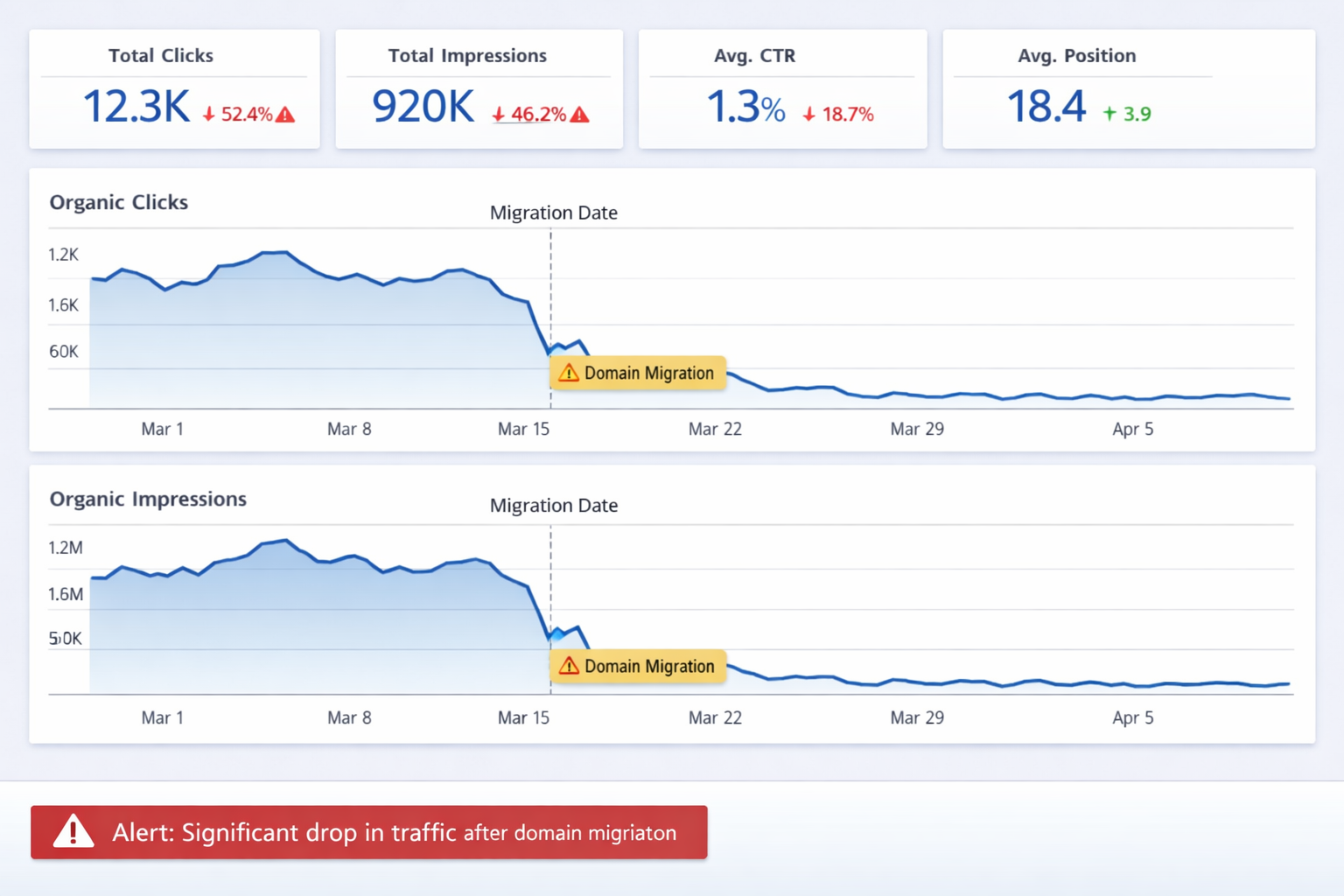
Organic traffic loss during a domain migration is not a question of if, it’s a question of degree and duration. Any business planning a site migration needs to model what a 20%, 40%, or 60% traffic drop would mean for lead generation and revenue during the domain migration recovery period. This is not pessimism; it’s responsible planning. The recovery budget, covering monitoring tools, technical fixes, content improvements, and potential link building on the new domain, should be allocated before the domain migration happens, not after the traffic drops.
Rollback options must be defined before the domain migration goes live. While rolling back a site migration is complex and carries its own SEO risks, having a defined rollback plan means the team knows exactly what steps to take if the domain migration produces catastrophic results in the first days post-launch.
Operational Continuity During a Site Migration
Email addresses tied to the old domain must be managed as part of the broader domain migration plan. A site migration that changes the website domain without addressing email continuity creates significant operational disruption, especially where the business uses domain-specific email for client communications, contracts, or billing. The domain migration plan must specify how long the old domain’s email infrastructure will remain active and how existing customers will be informed of the change.
Paid advertising campaigns referencing the old domain must be updated as part of the migration. Google Ads, Meta campaigns, and any other paid channels pointing to old-domain landing pages must be updated at launch or within the first hours post-migration to prevent paid traffic being sent to redirect-handled pages rather than native new-domain URLs, a critical consideration for both Quality Score and conversion rate continuity.
Communication and Brand Trust After a Domain Migration
Users who have bookmarked old URLs, stored them in CRM systems, or shared them in email threads will arrive on the new domain via redirects. While 301 redirects handle this technically, a proactive communication strategy, notifying existing clients and subscribers of the domain migration before it happens, significantly reduces friction and preserves trust. A well-handled rebrand communication reinforces confidence. An unexplained domain migration erodes it.
Brand trust around the new domain itself must also be evaluated independently of the SEO impact. A new domain name that doesn’t obviously connect to the brand, or that uses an unfamiliar extension, can reduce organic click-through rates even if rankings recover, undermining the entire purpose of the domain migration regardless of the technical execution quality.
Measuring Domain Migration Success: What Signals Matter Post-Launch
Post-domain-migration monitoring is not a passive exercise. It requires active daily review in the first weeks and structured weekly reporting through the full recovery period. The key signals fall across three categories: technical health, search visibility, and business outcomes. New Perspective Design recommends formal reporting across all three categories throughout the domain migration recovery window.
Technical Health Signals
- Crawl error rates in Search Console, look for spikes in 404s or server errors that indicate redirect failures in the domain migration redirect map.
- Indexed page counts on the new domain, should grow progressively post-migration and match the expected URL count within weeks.
- Coverage report in Search Console, pages should move from “discovered but not indexed” into indexed status as Google processes the domain migration.
- Redirect validation, run scheduled crawls to confirm all domain migration redirects are resolving correctly and no new chains have appeared.
- Core Web Vitals on the new domain, confirm the site migration hasn’t introduced performance regressions that affect ranking signals.
Search Visibility Signals
- Ranking positions for primary target keywords, track weekly against the pre-migration benchmark throughout the domain migration recovery period.
- Impression data in Search Console, impressions typically recover before clicks during a site migration, making this a valuable leading indicator of recovery trajectory.
- Organic click-through rate, a stable CTR at lower impression volume is less concerning than a CTR collapse at unchanged impression volume post-migration.
- Coverage of high-value pages, confirm that the pages carrying the most organic traffic pre-migration are indexed and ranking on the new domain.
Business Outcome Signals
- Organic leads and conversions, compare weekly against the same period in the prior year to account for seasonality rather than comparing only against the pre-migration period.
- Direct traffic, should remain stable if the brand communication strategy around the domain migration has been effective.
- Paid campaign performance, confirm no Quality Score degradation or conversion rate drop tied to the domain migration.
- Returning user rates, a significant drop in returning users suggests the old-to-new domain continuity has failed somewhere in the migration.
What a Failed Domain Migration Looks Like, and How to Respond
To help Google understand your new website faster and improve the indexing of the new pages, there are a few additional steps you can take.
- Point your business social media pages to the new domain.
- Update your Google Business Profile listing to the new domain.
- Encourage visitors to use the new domain, as increased traffic can help prompt Google to crawl the content more frequently.
“A domain migration is not just a technical change. It also needs strong supporting signals across your digital presence to help Google recognise and trust the new domain more quickly.” Juan Preuyt
The signals of a failed domain migration are distinct from the normal volatility every site migration produces. Volatility is temporary fluctuation that begins to stabilise after two to four weeks. Failure is sustained decline that doesn’t reverse, missing pages that don’t reappear in the index, or organic traffic that falls and continues falling with no recovery pattern emerging.
Common causes of failed domain migrations include: mass redirects to the homepage rather than page-level equivalents; a significant percentage of redirect failures producing 404 errors; the new domain being blocked by robots.txt or noindex tags set during development staging that weren’t removed at launch; or the Change of Address tool not being used in Search Console, leaving Google to discover the domain migration organically rather than through a formal notification.
If a domain migration is producing failure signals rather than volatility signals, immediate action is required. Audit every redirect in the migration map against the live site to identify failures. Verify the new domain is fully crawlable with no blocking directives. Check Search Console for manual actions or structured data errors introduced by the site migration. Engage specialist technical SEO support, the window for corrective action narrows quickly after a failed domain migration.
A domain migration is not a set-and-forget event. It is a months-long process that requires active management, regular monitoring, and the willingness to identify and fix problems as they surface. The businesses that recover fastest from a site migration are the ones that treat post-migration monitoring with the same seriousness as the migration itself, and never stop paying attention to what the data is telling them.
Final Considerations Before You Commit to a Domain Migration
A domain migration should not happen because the new domain name is appealing or because a rebrand feels overdue. It should happen because the business case is clear, the risks have been properly quantified, the technical migration plan is complete and peer-reviewed, and the team responsible for execution has the SEO expertise to carry it through without compromising organic visibility.
If there is any ambiguity about whether the old domain carries historical penalties or algorithmic suppression, that question must be resolved before a redirect strategy is chosen. The cost of inheriting a penalty on a brand-new domain, where you’ve simultaneously lost the aged-domain trust signals from the old one, is far higher than taking the time to investigate thoroughly before the site migration begins.
For businesses in South Africa considering a domain migration as part of a rebrand or structural business change, the local SEO context matters alongside the general principles. Links from South African directories, .co.za domain trust signals accumulated over years, and local search visibility built through consistent NAP citations are all part of what’s at risk in a domain migration. A thorough migration plan must account for all of these, not just primary keyword rankings.
New Perspective Design works with businesses across South Africa, from Johannesburg and Pretoria to Cape Town, Durban, and East London, to plan and execute domain migrations that protect organic visibility and preserve the search authority built over years of SEO investment. Whether you are navigating a straightforward rebrand migration or a more complex site migration involving a penalised domain, the approach must be methodical, the monitoring must be continuous, and the strategy must be built around your domain’s specific history, not a generic checklist.
Approach the domain migration process with the seriousness it deserves, execute it with precision, and monitor it without interruption, and a domain migration can be navigated without sacrificing the organic visibility your business depends on.













0 Comments