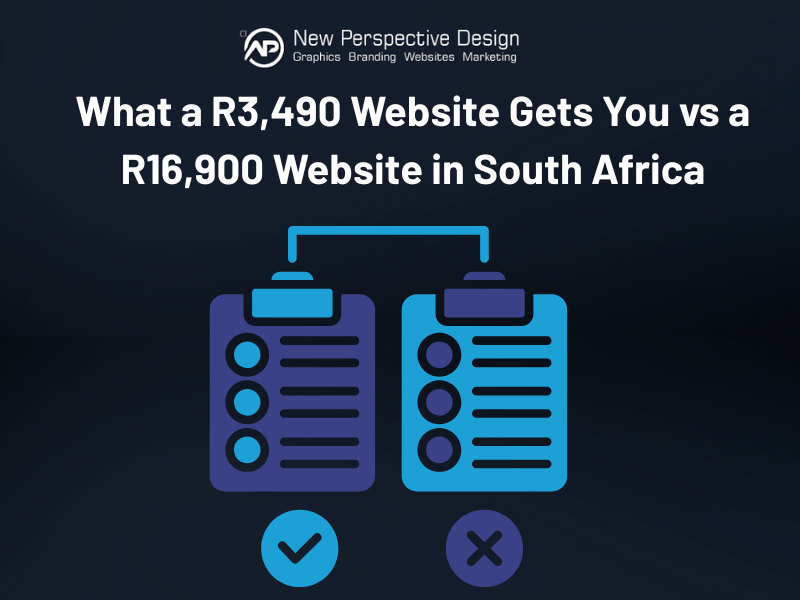
A R3,490 website in South Africa gives you a clean, credible 3-page online presence — home, about, contact — with mobile design, WhatsApp integration, basic SEO, and Google My Business setup. A R16,900 website gives you a 12 to 20-page custom WordPress build with advanced SEO architecture, API integrations, deep internal linking, and a full lead capture ecosystem. The difference is not just size. It is what the website can competitively do for a business in search results.
Introduction
When a South African business owner sees a R3,490 website and a R16,900 website side by side, the first question is almost always: what am I actually getting for the extra money?
It is the right question. But it is usually framed the wrong way.
The price difference between these two tiers is not primarily about design quality or effort. It is about what the website can structurally do — how many search queries it can target, how deeply it can cover a topic, how many user journeys it can support, and how completely it can represent a business that has grown beyond a founding idea into an established operation with multiple services, existing systems, and genuine competitive ambitions.
At New Perspective Design, we build both. The R3,490 Starter package and the R16,900 Enterprise package serve different businesses at different stages — and the honest answer to “which one do I need?” depends entirely on what the business is trying to achieve, not on what sounds impressive in a quote.
This article breaks down exactly what each price point delivers, who each one is genuinely built for, and when spending more — or less — is the right decision.
Side-by-Side: What Each Package Actually Includes
| R3,490 Starter | R16,900 Enterprise | |
|---|---|---|
| Pages | Up to 3 (Home, About, Contact) | 12 to 20 custom pages |
| Build type | Custom WordPress | Custom WordPress |
| Mobile responsive | ✓ | ✓ |
| WhatsApp integration | ✓ Chat button | ✓ WhatsApp + Facebook Chat |
| SEO setup | Basic — GMB + on-page foundation | Advanced — pillar architecture, deep internal linking, entity reinforcement |
| Google My Business | ✓ Setup included | ✓ Setup + Maps integration |
| Images | 5 free stock images + editing | Custom image curation |
| CMS | ✓ Update your own content | ✓ Update your own content |
| Blog / case studies / projects | ✗ | ✓ Full content loop |
| API integrations | ✗ | ✓ Payment gateways, CRMs |
| Custom functionalities | ✗ | ✓ 2 custom functionalities |
| Newsletter + booking forms | ✗ | ✓ Full lead capture ecosystem |
| Social media integration | ✓ | ✓ |
| Maintenance support | ✗ | ✓ |
| Hosting | Optional 1 month free | Optional 1 month free |
| Deployment | ✓ Full setup on any hosting | ✓ Full setup on any hosting |
| Once-off, no monthly fees | ✓ | ✓ |
Who the R3,490 Website Is Actually Built For
The R3,490 Starter is not a compromise product. It is the correct starting point for two specific business profiles — and understanding which one you are determines whether this is the right investment.
Profile 1: The startup building an online foundation
A new business that is still finding its footing — still learning what services clients actually request, still building a client base, still refining the positioning — does not need a 20-page website. It needs a credible online presence that can be found by people searching the brand name, backs up its social media presence, and gives prospective clients somewhere professional to land.
For this business, a clean 3-page website with real SEO foundations, proper Google My Business setup, and WhatsApp integration does exactly what it needs to do. The bigger, better website comes later — and critically, it comes with the benefit of what the business has learned from its first months of actual client enquiries.
“We often see the upgrade website moulded by what a business learns at the starter stage. Client enquiries tell you what people actually want. The 5 or 20-page build that comes after is sharper because of that real-world feedback — it is not built on assumptions about what the market needs,” says Juan Preuyt, founder of New Perspective Design.
Profile 2: The established business that just needs a reference point
Some business owners come to us with strong brand recognition, an established client base built through relationships and referrals, and a track record that does the sales work before the website ever enters the conversation. They do not need the website to generate cold leads. They need it to exist — professionally — so that when a referred prospect Googles the business name to verify it, what they find matches the standard of the business they have been told about.
For this profile, 3 pages is genuinely enough. A well-built home page, a credible about page, and a clear contact page — with real GMB setup so the Google Business Panel appears correctly — is the right level of investment for what the website actually needs to do.
This is also the profile that tends to run social media marketing, email campaigns, or Google Ads pointing traffic to the website. All of that marketing needs somewhere to point. Users who see a Facebook ad often Google the brand name before contacting. A clean, credible website that confirms the business is real and professional is the conversion mechanism — not the discovery mechanism.
What R3,490 clients commonly misunderstand:
The most frequent conversation we have with Starter clients is about service pages. A business owner with eight or ten service lines wants to write a full description of every service — and fit all of that onto a single services section within the about page or home page.
A page attempting to cover ten services in a single section creates two problems. First, the user experience suffers — visitors cannot navigate to the specific service they need without scrolling through everything else. Second, the SEO potential is compressed — a single page targeting ten different service keywords will not rank as well as ten dedicated pages, each with focused content and proper heading structure.
We are direct about this limitation upfront. Three pages cannot compete in organic search the way ten or twenty pages can. Many clients understand this, choose the starter build as their immediate need, and plan to scale when they are ready. That is a legitimate strategy. What it is not is a misunderstanding — both parties need to be clear about what the build can and cannot do before the project starts.
Who the R16,900 Website Is Actually Built For
The R16,900 Enterprise package is for a different conversation entirely.
The businesses that come to us at this level are typically established SMEs — with a meaningful product or service line, existing operational systems, and genuine competitive ambitions in search. They are not just formalising an online presence. They are building a platform designed to rank, convert, and scale.
Clients we have delivered at this tier include Catercom in Pretoria, Buzz Movers in Johannesburg, and Young Boys Beverages in Johannesburg — businesses with established operations, defined service lines, and existing systems that need to connect to the website.
What this investment delivers that the Starter cannot:
Search competitive architecture. With 12 to 20 pages, the website can target multiple search queries with dedicated, focused pages — one per service, one per location, one per product category. Internal linking can be built as a proper pillar structure, with supporting cluster pages reinforcing the authority of core service pages. The website can begin building topical authority rather than simply existing as an indexable property.
Advanced SEO depth. The SEO setup at this tier goes significantly beyond the foundation. Keyword mapping across every page. Entity reinforcement through structured content, consistent naming, and proper schema. Deep internal linking that passes authority between related pages. Specialised pages targeting long-tail search phrases that a 3-page site could never accommodate. When a client shares a link from this kind of website, they can share a specific service page — not a single page with every offering crammed into it.
Integration with existing business systems. Established businesses at this level are running CRMs, accounting software, inventory systems, and operational platforms. The website needs to connect to those — payment gateway integration, CRM lead routing, booking systems, newsletter platforms. These are not optional extras at this investment level. They are part of making the website a functional piece of the business’s operational infrastructure.
A full lead capture ecosystem. Newsletter signup, custom booking forms, multiple contact pathways, Facebook Chat in addition to WhatsApp, a blog or case study loop that keeps the site active and generates fresh content — all of this is built in from the start, not bolted on later.
What R16,900 clients commonly misunderstand:
The most consistent conversation at this tier involves scope. A business owner investing R16,900 in a website sometimes arrives with a mental model closer to a SaaS platform — expecting user dashboards, member login portals, AI chat systems, and custom application functionality as standard inclusions.
Two custom functionalities are included in the Enterprise package. A full CRM portal, a member dashboard, a booking engine with dynamic availability, and an AI chat integration are not — those are custom development projects that go beyond a website build and are quoted and scoped separately.
The line between a website and a software application is one of the clearest boundary conversations we have with Enterprise clients. A website is a content and conversion platform. A software application is a product. The two can coexist and integrate — but they are not the same thing, and the Enterprise package delivers the former, not the latter.
The Design and User Experience Difference
This is where the investment difference becomes visible to a real visitor.
With 3 pages, every design decision involves trade-offs. How much content can fit on the home page without becoming overwhelming? Which services get mentioned and which get left out? How do we guide a visitor from landing to contact without the intermediate steps — services detail, proof, trust signals — that a multi-page site handles naturally?
A well-built 3-page site does this acceptably. But it does it under constraint. The designer is working with limited real estate.
With 12 to 20 pages, those constraints disappear. Each service gets its own page — with space for a proper description, a process explanation, relevant imagery, and a focused call to action. The about page is not competing for space with the services section. The case studies or project portfolio is not crowding the contact page. Every element of the website has room to do its job properly.
The result is a user experience that is cleaner, more navigable, and more effective at guiding different types of visitors — each at a different stage of the buying decision — toward the appropriate next step.
This does not mean a 3-page site looks worse. It means a 20-page site can do more — because it has more space to work with and a more sophisticated internal structure to guide visitors through.
The SEO Difference Is Significant
At R3,490, the SEO setup builds the foundation. Title tags, meta descriptions, heading hierarchy, image alt text, sitemap, Google Search Console, Google My Business — all done properly, all positioned to start the clock on Google’s understanding of the business from day one.
What a 3-page site cannot do: rank competitively for multiple distinct search queries simultaneously. Three pages means three URLs that Google can index and rank. If a business has five services it wants to rank for, a 3-page site cannot address that structurally.
At R16,900, the SEO setup is a different exercise entirely. Keyword research informs the page structure before a single line of code is written. Each service page targets a specific search intent. Internal linking is planned as a pillar-and-cluster architecture — with core service pages supported by related content that passes authority and depth of topic coverage. Entity signals are reinforced throughout the site structure. Schema markup is applied where relevant.
The practical difference: a 20-page site built with this architecture is competing in organic search from a structurally stronger position than a 3-page site will ever reach — regardless of how well the 3-page site is built within its constraints.
“The SEO difference between these two tiers is not just about more pages. It is about what you can architecturally do with more pages. Pillar pages, cluster content, deep internal linking, entity reinforcement — these are things a 3-page site simply cannot support structurally. When a client wants to compete in organic search for multiple services, the starter package is the beginning of the conversation, not the answer to it,” says Juan Preuyt, founder of New Perspective Design.
When R3,490 Is Genuinely the Right Answer
- You are a new business and you are still learning what your market actually needs from you
- You have an established reputation built through relationships, and the website’s job is to verify — not to generate
- You are running social media, email, or paid advertising and need a credible destination for that traffic
- You want to start the Google clock ticking — get indexed, get GMB set up, start building domain age — while you plan the bigger build
- Your budget is genuinely limited and a well-built 3-page site is better than a poorly built 10-page site
When R16,900 Is the Right Answer
- You have an established business with multiple distinct services or products that each deserve their own page
- You want to compete in organic search for specific keywords — not just be found by people who already know your name
- You have existing systems — CRM, payment gateway, booking platform — that need to integrate with the website
- You are ready to invest in a full lead capture ecosystem, not just a contact form
- You understand that the website is an operational asset, not a one-time purchase, and you are prepared to maintain and grow it
When Neither Is Quite Right
There is a tier between these two — the R5,590 Small Business package (5–9 pages) — that suits the business that has outgrown three pages but is not yet at enterprise scale. This is the most common package for South African SMEs that want to compete locally in search, have three to five core services, and want a proper website without the complexity of API integrations and custom functionality.
See the full website packages page for a complete breakdown of all tiers, or use the Website Cost Calculator to estimate which package fits your specific situation.
Real Clients at Each Tier
At the R3,490 Starter tier:
- Amazing Grace — a clean, credible online presence to support an established brand
- The 2 Brothers Pizza (Ekurhuleni, Gauteng) — a local food business needing a professional online reference point
- Canpack Solutions (Johannesburg) — a business with existing client relationships needing a website to formalise its digital presence
At the R16,900 Enterprise tier:
- Catercom (Pretoria) — an established business with complex operational needs, SEO ambitions, and existing systems requiring integration
- Buzz Movers (Johannesburg) — a competitive service business in a saturated market needing a website that could rank and convert at scale
- Young Boys Beverages (Johannesburg) — a product business with multiple lines requiring a full content and commerce architecture
FAQ
What is the difference between a R3,490 and R16,900 website in South Africa? The R3,490 Starter is a 3-page custom WordPress website — home, about, contact — with basic SEO, Google My Business setup, WhatsApp, and a full CMS. The R16,900 Enterprise is a 12 to 20-page custom build with advanced SEO architecture, API integrations, a full lead capture ecosystem, a blog or case study loop, and two custom functionalities. The core difference is structural SEO capacity and the ability to compete for multiple search queries simultaneously.
Is a R3,490 website worth it in South Africa? Yes — for the right business at the right stage. A startup building its first online presence, or an established business that needs a credible reference point rather than a lead generation engine, gets genuine value from a well-built 3-page site. The key is being honest about what three pages can and cannot do in organic search.
Can a R3,490 website rank on Google? It can rank for brand name searches and potentially for low-competition local searches. It cannot competitively rank for multiple distinct service keywords simultaneously — because it only has three pages to work with. For competitive organic search visibility across multiple services, more pages are required.
What does the R16,900 website include that cheaper packages do not? Advanced SEO architecture across 12 to 20 pages, API integrations with payment gateways and CRMs, two custom functionalities, custom image curation, Facebook Chat in addition to WhatsApp, a newsletter system, custom booking forms, a blog or case study content loop, and website maintenance support.
Is there a package between R3,490 and R16,900? Yes. The NPD Small Business package at R5,590 covers 5 to 9 pages — the right tier for businesses with three to five core services that want to compete locally in search without the complexity of enterprise-level integrations. It is the most common starting point for South African SMEs.
When should a business wait before investing in a R16,900 website? When the business is still figuring out what its market actually needs. The best enterprise-level websites are often built after a business has operated for a year or two at starter level — because the client enquiries, the service mix, and the audience understanding that come from real operation produce a sharper, more accurate brief than any assumption made at launch.
Does the more expensive website guarantee better results? No website guarantees results — at any price. What a larger investment buys is structural capacity: more pages, better SEO architecture, deeper integration, and a fuller content ecosystem. Whether that capacity produces results depends on ongoing SEO work, marketing investment, and the quality of the content that populates the structure after launch.
Conclusion
The difference between a R3,490 and a R16,900 website is not the difference between bad and good. It is the difference between a focused, credible foundation and a full competitive platform.
Neither is the right answer for every business. The R3,490 site serves the business that needs to exist online professionally, at an honest price, without overcommitting to complexity before it is needed. The R16,900 site serves the business that is ready to compete — in search, in conversion, and in the operational integration that turns a website into a functioning part of how the business runs.
The most expensive mistake in web design is not spending too little. It is spending at the wrong level for where the business actually is — either underinvesting and limiting what the website can structurally do, or overinvesting in complexity before the fundamentals have been proven.
For a full picture of website pricing at every tier in South Africa, see our Website Cost Guide. To find the right package for your specific business, visit our website packages page or use the Website Cost Calculator.