
A year ago most of your customers found you through Google. A good chunk of them still do. But a growing number are now typing their question into ChatGPT or Gemini, reading the answer, and never seeing a single search result. If your business is not mentioned in that answer, you were not beaten by a competitor. You were invisible.
That is the part that unsettles most business owners we speak to at New Perspective Design. Not that they are ranking lower, but that they cannot see whether they are in the conversation at all. So how do you get your website to show up in AI?
So this article does two things. It explains what showing up in AI actually takes, in plain terms, for someone running a business rather than a marketing department. And it calls out the growing pile of nonsense being sold around it, because there is a lot of it, and some of it is expensive.
We are going to be blunt. New Perspective Design has been testing this for close to three years across our own site and our clients’ sites. Some of what we found flatly contradicts the advice you will read everywhere else, including from agencies charging a premium for it, this is nothing new to digital marketing we have seen this in SEO for over ten years.
Is AI Actually Sending Customers to your website?
Short answer: yes, but not evenly.
When someone asks an AI assistant “who does website design in East London” or “best commercial diving company in South Africa,” the assistant gives them a shortlist. That shortlist is built from what the model has learned about the web and, in some tools, what it pulls live at the moment of the question. Your business is either in that shortlist or it is not.
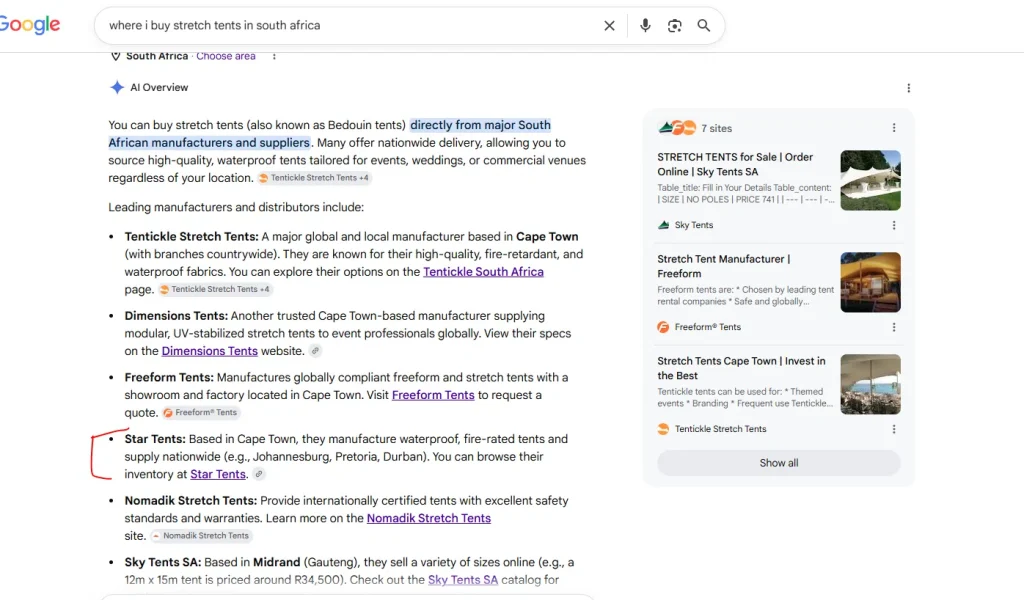
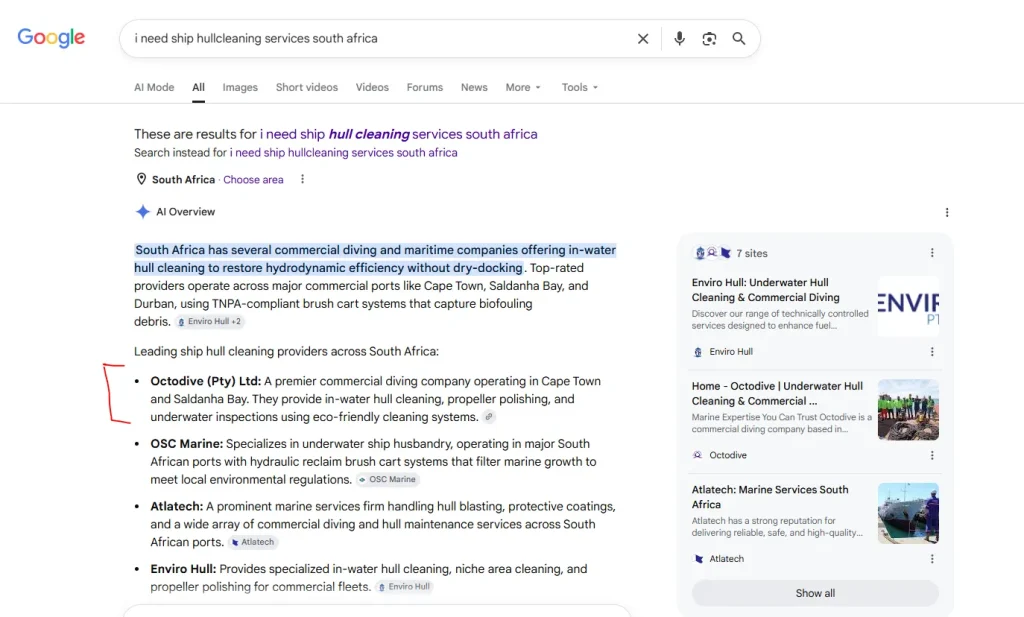
Here is what is easy to miss. This is not future tense. New Perspective Design has watched its own clients get named in AI answers already. Octodive, Star Tents and Catercom all surface in Google’s AI Overviews for their core queries, and so does New Perspective Design for ours. That is happening now, in South Africa, in real categories, for real businesses we do the work for.
The reason most owners have not noticed is simple. You do not see it unless you go looking, and almost nobody is looking, because there has been no easy way to look. More on that further down, because it matters a lot. You can just simply log into you Google Analytics console and you will see referring source/ medium. Even more interesting go and look at your website server logs and you will if you have a public website probably see AI bots crawling your content.
What Is AEO, and Is It Really a Whole New Game?
You will see two acronyms thrown around.
- AEO stands for Answer Engine Optimisation. It means shaping your web presence so AI answer engines like ChatGPT and Gemini reference you.
- GEO stands for Generative Engine Optimisation. Same idea, different label.
Park both of those terms now. We only defined them so you recognise them when a salesperson uses them on you. For the rest of this article we will just call it showing up in AI.
And here is where New Perspective Design parts ways with most of the industry.
Showing up in AI is not a whole new game. It is different in one specific layer, and we will get to that layer, but the foundation is the same foundation good SEO has always stood on. A clearly described, trustworthy brand, with consistent and accurate information about what it does, published by a source people and machines already respect. That is Experience, Expertise, Authoritativeness and Trustworthiness, the thing Google calls E-E-A-T. It is roughly 70% of what makes you show up in an AI answer, and it is roughly 70% of what already makes you rank in normal search.
Sit with that number for a second, because it undoes a lot of what is being sold to you.
If 70% of AI visibility overlaps with SEO, then the companies selling you a separate SEO package and a separate AEO package are, for the most part, selling you the same work twice with two invoices. Some South African agencies quote R30,000 or more a month for the AEO layer alone, on top of your existing SEO. New Perspective Design thinks that is unnecessary. It is different enough to need people who study it, and it is not different enough to be a brand new product line with a second bill attached.
Why Does AI Visibility Feel So Unstable Right Now?
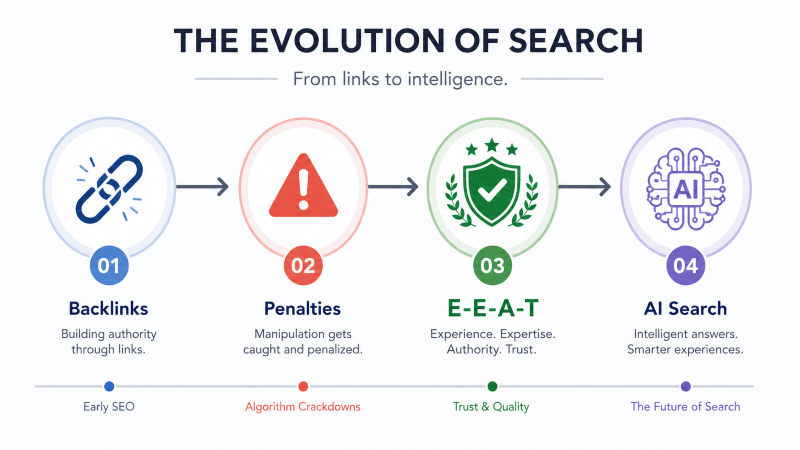
This is the layer that genuinely is new, and it is worth understanding because it explains almost everything else.
AI as a technology is about three years into the mainstream. But the search and discovery side of it, the part where being visible actually sends you customers, is far younger than that. It is not a settled system. It moves.
New Perspective Design has seen this movie before. Think about how Google evolved.
- First, backlinks were the shortcut. Point enough links at a site and it ranked. So people gamed it.
- Then came link wheels, private blog networks, cloaking, keyword stuffing. Whole industries sprang up to exploit the loophole.
- Google fought back with penalties, then RankBrain, then a hard turn toward user experience, then E-E-A-T.
Every one of those shifts flattened a shortcut that thousands of people had built a business on. The ones who read, studied and adjusted survived. The ones selling last year’s trick did not.
AI discovery is at the very start of that same road. It is closer to Google in 2005 than to Google today. That is why what worked last month can wobble this month. It is not broken, it is young, and young systems get tweaked constantly while the people running them figure out what a good answer looks like.
Here is a live example you can watch age in real time. Right now the standard advice is to put a clean answer to the question at the very top of your page, phrased and rephrased so a model can lift it easily. It works, for now. We have seen this exact pattern before. In early Google you could rank a page by stuffing the keyword and repeating the question and answer in a handful of different wordings near the top. Google grew out of it. Today a page can answer a query, and rank for it, without containing that exact phrase anywhere, because the system reads meaning rather than matching strings. AEO and GEO will travel the same road. The answer capsule at the top of the page is a moment-in-time tactic, not a durable strategy. The bigger signal is already visible underneath it. Models lean on larger, more established brands as safer sources to reference, which means authority is doing more of the work than any neatly formatted answer box. There is already more to this than a capsule at the top of a page, and there will be less of the capsule as the systems mature.
Two honest conclusions come out of this.
One, anyone promising you a fixed formula that guarantees AI rankings is either new to this or lying. Consistency is not something this space offers yet.
Two, that volatility is exactly why you need someone whose job is to keep up. Not to chase every rumour, but to separate the shift that matters from the noise. This has always been true in SEO. It is more true here, because the ground is moving faster. It is the core reason New Perspective Design treats AI search visibility as an ongoing discipline, not a once-off setup.
The Things Everyone Is Selling You That Do Nothing
This is the part we get the most argument about, because it contradicts a stack of popular blog posts. Read almost any current guide on how to show up in AI and you will be told to add schema, deploy an llm.txt file, and go earn citations. New Perspective Design tested all of it. Here is what we actually found.
Schema markup does not help you show up in AI. The Ahrefs study on this found no relationship between schema and AI visibility, and New Perspective Design’s own testing across client sites lines up with that result. Schema is still worth having for other reasons in normal search, and Google is also depreciating this becase of abuse, but if someone tells you adding schema will get you into ChatGPT answers, that is not supported by the data.
An llm.txt file does nothing. The idea sounds clever. Drop a file on your server that tells AI models about your site. In practice we have seen no effect from it whatsoever. It rests on the same false premise the next one does, that the models need you to hand-feed them a special, simplified version of your business. They do not. It is a solution to a problem the engines did not ask you to solve, and half the guides pushing it have never measured a result from it.
Markdown (.md) files for AI do nothing useful either. This one at least has an understandable origin. Developers live in markdown, and the early assumption among some SEOs was that feeding a model a stripped-down plain-text copy of a page would help it read cleanly inside a limited context window. It was a fair guess at the time. It is wrong now. The models read and parse rendered HTML, and they cope with CSS and a fair amount of JavaScript too. They do not need a simplified hand-fed copy of your page, and maintaining a parallel set of .md files just adds overhead to solve a problem the engines do not have.
“Citations” are widely misunderstood. You will read that you need to earn citations to show up in AI. The picture people paint is a neat quote, “According to Juan Preuyt, do these ten things.” That is not how it works. When AI references a business it attributes to the brand or entity, something like “according to New Perspective Design,” not a personal quote card. And if you actually read a spread of AI answers, a lot of them carry no visible citation at all. Chasing citations as your headline metric is aiming at the wrong target.
Notice the pattern in all four. They are tidy, technical, easy to sell as a package, and they let a provider show you a “we did the thing” deliverable. What they do not do is move you into the answer.
The AI Plugin and “Let AI Build Your Site” Trap
Now the bigger one, because it is where real money gets wasted.
There is a wave of products that promise to let AI build your entire website, or write all your content, and have it rank and get referenced. New Perspective Design has tested this properly, over a long stretch, and the results do not support the pitch.
AI content does not outperform human content. The best we have ever managed is heavily edited AI content, where a skilled human reshapes it so thoroughly that the AI was really just a first draft.
We have hard evidence sitting on our own site. New Perspective Design has an article on the cost of website design that was written long before AI writing tools existed. In almost three years we have not produced a single AI version that beats it. Not one. We have tried repeatedly.
That result is too consistent to be luck.We have been told even is SEO the engines are quietly discounting low-effort content, this is a broad application of the algorithm for SEO for AI. Google has all but said this out loud. When you flood their index with generic AI text, you are telling their systems your pages are not worth the crawl budget or the trust. Spam them with low-effort AI rubbish and they will not waste resources crawling and re-crawling you, and they are not about to degrade their own model by leaning on your filler.
This is why the “humanise your AI content” tool industry makes us laugh a little, and then worry for the people buying it. It is the link wheel all over again. Backlinks got gamed, so link wheels and cloaking and content spinners appeared to fake the signal at scale, and every one of those tricks eventually fell flat when the system caught up. Faking human effort so a machine cannot tell is the same bet with a new coat of paint. Systems evolve. Gaming them catches up with you. It always has.
The clients who come to New Perspective Design with a generic AI brief and a pile of generic AI content are usually surprised when we can tell at a glance. If we can tell, the engines can tell, and they may filter this stuff out.
Which AI Engines Should You Even Care About?
Here is where a sober head saves you money.
Cast your mind back to normal search. There was never one search engine. There was Google, Bing, Yandex, DuckDuckGo, Yahoo and more. You did not optimise for all of them. You went where your customers actually were, which for most South African businesses meant Google, with a slice of Bing for certain audiences. You picked your battles.
AI is exactly the same, and anyone telling you to optimise equally for every assistant has not thought about your customers.
From what New Perspective Design can see, for the average South African business, this is roughly the order that matters:
- ChatGPT and Gemini are where most real customer questions are landing. These two carry the weight.
- Google’s AI Overviews matter because they sit on top of the search everyone already uses. This is where our clients are being named today.
- Claude shows up, but at low volume for customer discovery. Worth being aware of, not worth building a strategy around yet.
- Perplexity skews toward developers and deeper research queries. If your customers are technical, it matters more. If you sell tents or catering, it is not your priority.
A short comparison, since you deserve the mechanics without the jargon:
| Engine | Where the answer comes from | Who it matters to |
|---|---|---|
| ChatGPT | What it has learned about the web, plus some live retrieval | Broadest slice of everyday buyers |
| Gemini | Its own model plus Google’s live index | Broad, and tightly tied to Google search |
| AI Overviews | Pulled from pages already earning trust in Google | Anyone your existing SEO can reach |
| Claude | Mostly its trained understanding of the web | Present, low customer-discovery volume |
| Perplexity | Live crawl with visible sources | Developers and deep-research queries |
The takeaway is not “ignore the small ones.” It is “put your effort where your customers are asking,” which for most of you is a short list.
So What Actually Moves the Needle?
New Perspective Design is not going to hand you the full method, for the same reason a mechanic does not hand you their diagnostic sheet. But we are not going to be coy about the shape of it either, because the shape is not a secret. The execution is.
Everything that works points back to the same place. Be a genuinely trusted brand, with a clear and consistent story about what you do, told the same way everywhere you appear, backed by real experience a machine can verify against the rest of the web. That is E-E-A-T doing the heavy lifting, and it is why so much of showing up in AI folds back into good, ordinary, well-executed SEO.
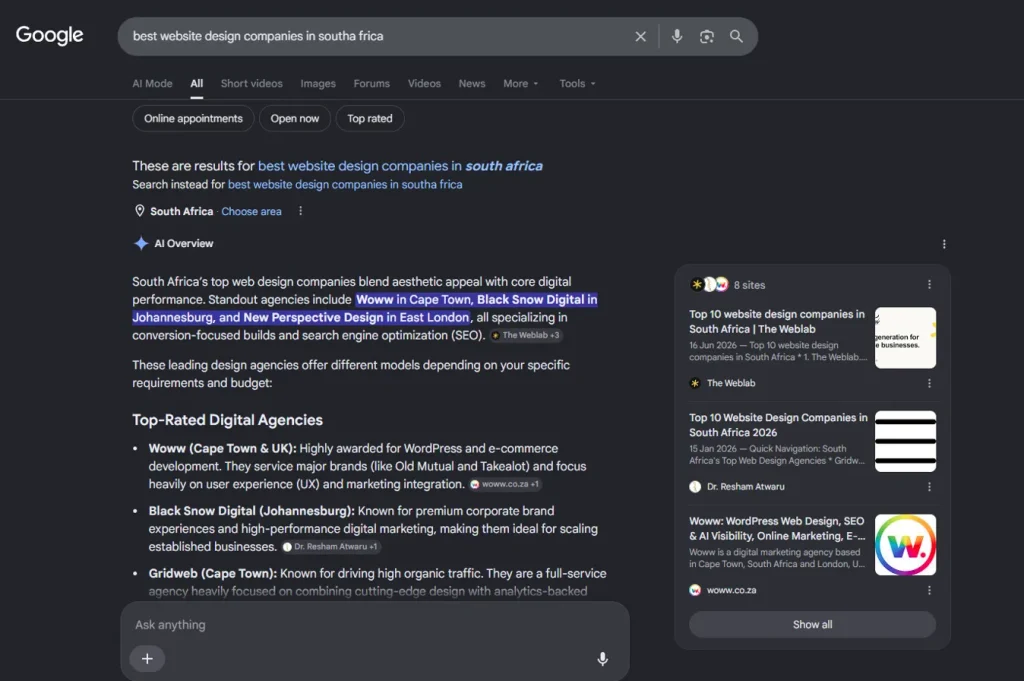
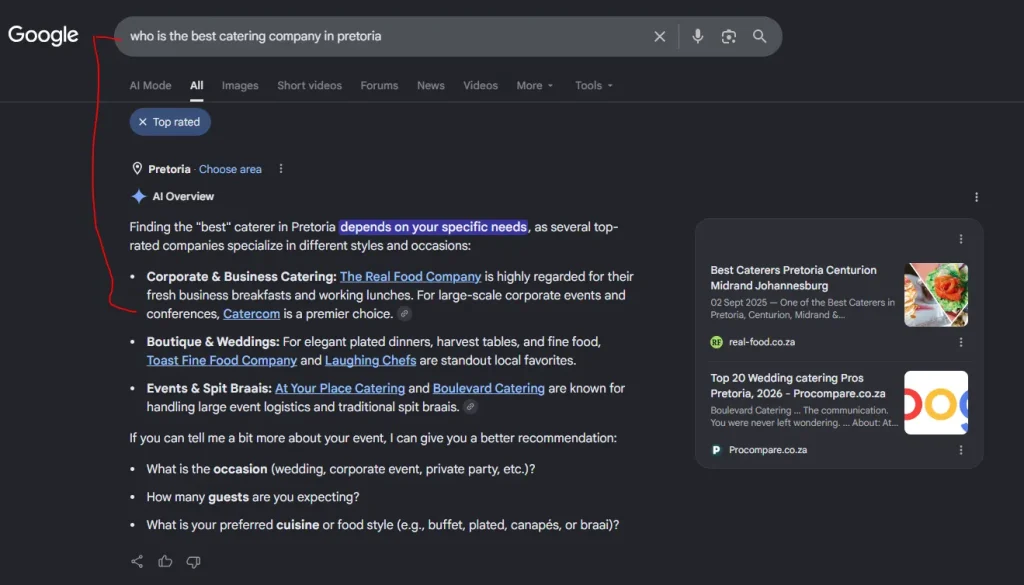
The proof that this works is not theoretical for us, and it is not a claim you have to take on trust. These are live Google AI Overview results for real buyer searches, and every business named is a New Perspective Design client.
| The search a customer typed | What Google’s AI Overview returned |
|---|---|
| i need ship hull cleaning services south africa | Names Octodive (Pty) Ltd as a premier commercial diving company for in-water hull cleaning |
| where i buy stretch tents in south africa | Names Star Tents as a nationwide stretch tent manufacturer and supplier |
| who is the best catering company in pretoria | Names Catercom as a premier choice for large-scale corporate catering |
Four different industries, four genuine high-intent searches, four businesses put in front of the buyer at the exact moment of decision. None of them got there by adding an llm.txt file or spinning AI content. They got there because New Perspective Design made them clearly and consistently the trustworthy answer to the question a customer was asking.
It is not theoretical for New Perspective Design’s own brand either. Search Google for the best website design companies in South Africa and its AI Overview names New Perspective Design among the standout agencies, in a national, competitive query, sitting alongside firms that sell AI visibility as a premium add-on. We did not buy a package or drop a file on the server to get there. We got there the same way our clients did. The gap between knowing what works and executing it well is the whole job, and that gap is where an agency that actually studies this earns its keep.
How Do You Vet Anyone Selling You SEO or AI Visibility?
This is the most useful ten minutes you can spend before you sign anything, and it costs nothing.
The principle is simple. Anyone selling you SEO, AEO or AI visibility should be able to show it working on their own business first. A plumber with burst pipes in his own kitchen is a hard sell. Here are three checks any business owner can run without technical help.
- Check their traffic. Drop the agency’s own website into a free tool like Semrush and look at their organic search traffic. A company that sells SEO for a living and pulls almost no organic traffic to its own site is a flag worth noticing.
- Search for what they sell, not who they are. Open an incognito window and search for the actual service, something like “SEO company” plus their city, not their brand name. If they only appear when you type their company name in, they are not ranking for the terms that win new clients, which is the exact thing they want to charge you for.
- Ask the machines. Search Google for the best version of their service in their city, or ask ChatGPT or Gemini the same question, and see whether the answer names them at all. If they promise to get you into AI answers but cannot get themselves there, that is worth a question or two.
None of these is an outright dealbreaker, and we want to be fair about that. A brand-new agency, a recent rebrand, or a very niche specialism can all explain thin numbers. But a company that positions itself as an SEO or AI-visibility expert and comes up empty on all three is telling you something you should hear before you pay.
New Perspective Design holds itself to the same test, which is why the proof above sits in this article rather than tucked inside a sales deck.
How Do You Even Track If AI Is Recommending You?
This is the quiet problem underneath everything above, and almost nobody talks about it.
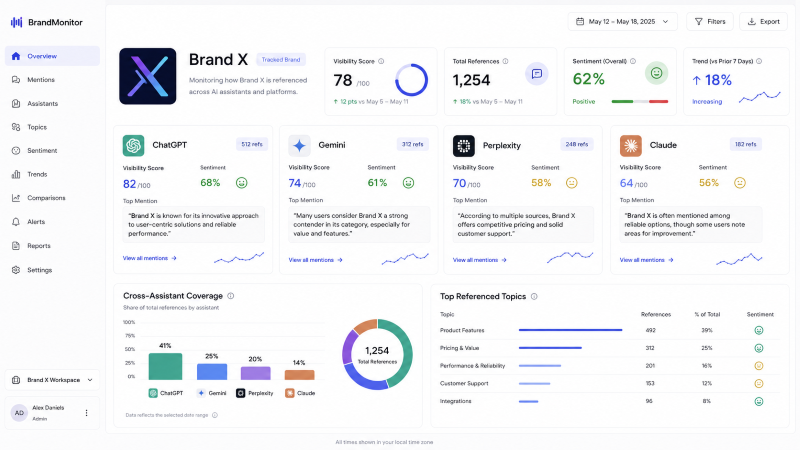
You cannot improve what you cannot measure. In normal search you have rankings, you have Search Console, you have clear numbers. In AI, the average business owner has nothing. You can type your own question into ChatGPT and see what comes back, but that is one query on one day, and the answer can change tomorrow. There is no dashboard sitting in front of you telling you whether AI is putting you or your competitor in front of buyers this week.
That is not a small gap. It is the difference between managing your AI visibility and guessing at it.
New Perspective Design tracks this properly. Not a once-off manual check, but systematic monitoring across the assistants that matter, so we can see whether a business is being referenced, for which questions, and whether last month’s work moved anything. The reason we lead with it is that without tracking, everything else is faith. With it, you can actually tell what is working and stop paying for what is not.
The Honest Takeaway
Let us be straight with you, because the fluffy version helps nobody.
Showing up in AI is real, it is growing, and if you sell to South African customers it already matters. It is not a separate universe from SEO, so be careful with anyone charging you twice for one job. The genuinely new part, the discovery layer, is young and volatile, which means there is no fixed formula and there will not be one for a while. The shortcuts on sale right now, the schema tricks, the magic files, the AI site builders, the humanising tools, are the same shortcuts that failed in every previous era of search, dressed up for a new one.
What lasts is boring and hard. A trusted brand, clear and consistent information, real human effort, and someone paying close enough attention to move with a system that shifts monthly. Gaming it will catch up with you. Doing it properly will not. That is the whole philosophy New Perspective Design builds on.
If you have read this far, you are already ahead of most business owners, who still do not know AI search exists.
Find out where you actually stand
The honest first step is to stop guessing. Let New Perspective Design show you exactly whether AI is recommending your business or handing that customer to a competitor, across the assistants your buyers actually use. If the picture is good, you will know what is protecting it. If it is not, you will know precisely what to fix, and in what order.
Book an AI visibility check with New Perspective Design and see what the machines are saying about you.
Frequently Asked Questions
What does it mean to show up in AI? It means that when someone asks an AI assistant like ChatGPT, Gemini or Google’s AI Overviews a question your business could answer, the assistant references or recommends you in its reply. If it does not mention you, you are effectively invisible to that customer, even if you rank well in normal search.
Is AEO different from SEO? Partly. The discovery layer, how AI decides who to reference, is new and moves quickly. But roughly 70% of what makes you show up in AI is the same trusted-brand, clear-information, E-E-A-T foundation that good SEO already builds. New Perspective Design’s view is that paying separately for SEO and AEO is usually paying twice for overlapping work.
Does schema markup help me show up in AI? No, not for AI visibility. The Ahrefs study on this found no relationship, and New Perspective Design’s own testing agrees. Schema still has uses in normal search, but it will not get you into AI answers.
Do llm.txt or markdown files help? In New Perspective Design’s testing, no. They add overhead to your site and return nothing measurable for AI visibility.
Does AI-written content rank and get referenced better than human content? No. In almost three years of testing, New Perspective Design has never had an AI version beat a strong human-written page, including our own long-standing article on the cost of website design. The best results come from heavily edited AI drafts, where a skilled human does the real work.
Which AI assistants should a South African business focus on? For most, ChatGPT and Gemini carry the most customer questions, with Google’s AI Overviews close behind. Claude is present but low for customer discovery, and Perplexity matters most for technical or research-heavy audiences.
Can I track whether AI is recommending my business? Not easily on your own. There is no simple dashboard for it yet, which is why most owners are flying blind. New Perspective Design tracks it systematically across the assistants that matter, so you can see whether you are being referenced and whether the work is moving anything.
How do I check whether an SEO or AI visibility agency is any good? Run three free checks before you sign. Drop their website into a tool like Semrush and look at their own organic traffic. Search in incognito for the service they sell, not their brand name, and see if they rank. Then search Google or ask ChatGPT for the best provider of their service in their city and see if the AI names them. None of these alone is a dealbreaker, but an agency selling expertise it cannot demonstrate on its own site is worth questioning.
Who is New Perspective Design? New Perspective Design is a South African web design, SEO and digital marketing agency with its head office in East London and a Gauteng base in Centurion, serving clients nationally. It is a certified Google Partner, holds back-to-back TechBehemoths Top Web Design Company awards for 2024 and 2025, has delivered over 300 websites, and holds a 4.9 star Google rating across more than 100 reviews. It is one of the few SA agencies actively testing what makes businesses show up in AI search.