

Roos Garage Doors Website Rebuild Case Study | New Perspective Design
Rebuilding a national garage door manufacturer's website, branch by branch
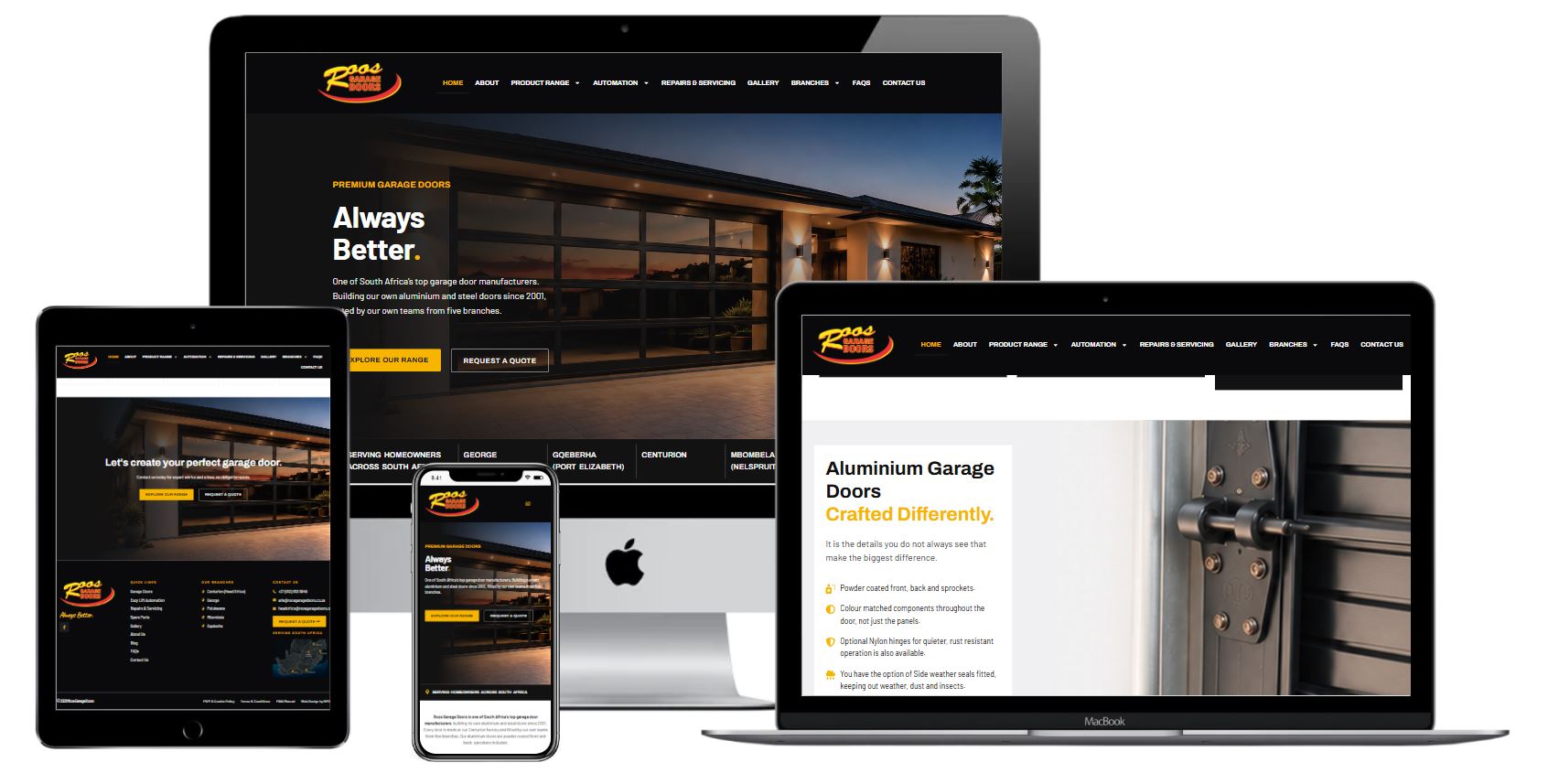
Roos Garage Doors manufactures its own aluminium and steel garage doors at a factory in Centurion and installs them through five branches: Centurion, George, Gqeberha, Mbombela and Polokwane. They came to us with a website that had grown for years without a structural plan behind it.
We rebuilt it across 35 pages, moved 22 old URLs with 301 redirects, gave each branch a page that can rank on its own, and turned a spare parts list into 26 individual part records capable of ranking for the parts themselves.
None of that is design work. It is technical SEO, and this case study sets out why each decision was made rather than what was delivered.
At a glance
The rebuild in numbers
| Measure | Figure |
|---|---|
| Total pages after rebuild | 35 |
| Existing URLs kept unchanged | 26 |
| New pages built | 8 |
| URLs moved | 1 |
| 301 redirects mapped | 22 |
| Duplicate pages retired | 8 |
| Branch pages, each with unique content | 5 |
| Spare part records built | 26 |
| Broken internal links corrected | 119 |
| Platform | WordPress with Elementor, custom post type for parts |
The starting point
What was wrong with the old site
Three structural faults. None visible to a visitor, all three costing search traffic.
| Fault | What it actually cost | What we did |
|---|---|---|
| Aluminium filed under steel, at /steel-doors/aluminium-doors/ | URL hierarchy states how topics relate. That URL told Google aluminium is a subtype of steel, so the aluminium range inherited its parent's topic instead of owning its own. It could never rank properly for aluminium garage door searches regardless of the copy on it. | Moved to /aluminium-doors/ as a top-level range with its own children, and redirected the old URL. |
| Repair copy on the hardware page competing with the service page | Keyword cannibalisation. Google has to choose between two pages targeting the same intent, splits the signals and often ranks the weaker one. Two mediocre pages where there should be one strong one. | Moved all repair content onto the service page, leaving the hardware page free to become a spare parts hub. |
| Spare parts existing only as a list | Every part is a search somebody is making with immediate intent. None had a page to land on, so that demand went to competitors. | Built 26 individual part records as a custom post type. |
| Dead internal links, 119 instances | Internal links carry authority between pages and are how pages get discovered. A link pointing nowhere is authority leaving the site. | Audited and corrected every one before launch. |

Technical SEO
Why we built the spare parts range as a custom post type
This was the most important technical decision on the project, and it is the one most often got wrong.
Garage door spare parts are not sold online here. Roos supplies them through branches, and springs in particular have to be specified by weighing the door rather than picked off a shelf. So WooCommerce, the obvious answer, was the wrong answer.
| WooCommerce | Custom post type | |
|---|---|---|
| Suits products that | Are bought online with a card | Are specified, quoted or fitted |
| Adds | Cart, checkout, payment, tax and shipping logic nobody uses | Nothing the site does not need |
| Page template | Built for transactions, price and buy button | Built for the question being asked |
| Fields available | Product attributes | What it does, how it is fitted, symptoms of failure, related parts |
| Managing 26 items | Product catalogue overhead | One consistent record type, hub page generated from it |
| Verdict here | Wrong tool | What we built |
The decision paid back in three ways.
Each part ranks on its own
Someone whose cable has snapped searches for a lifting cable, not for a garage door company. A page about lifting cables written by the people who manufacture them is the result that search deserves. Twenty-six part records is twenty-six chances to be the answer, rather than one hardware page trying to be the answer to all of them and ranking for none.
Topical authority lifts everything above it
Search engines assess how completely a site covers a subject. A site covering garage doors, the motors that drive them, the springs that balance them, the cables that lift them and the hinges that hold the panels is demonstrably an authority on garage doors. That depth raises the whole cluster, including the commercial pages at the top of it. The parts pages are not only earning their own traffic, they are making the door and automation pages stronger.
It multiplies AI surface area
AI Overviews and assistants answer by retrieving specific passages, not whole sites. A self-contained page answering "what does a centre bearing do and when does it fail" is exactly what gets retrieved. A row in a table is not.

Multi branch architecture
How do you structure a website for a business with multiple branches?
The temptation with five branches is one services page with the towns listed at the bottom. It is faster, and it ranks for nothing.
Local search works on relevance to a place, and a page naming five towns is not strongly relevant to any of them. The usual correction is worse: five pages with identical copy and the town swapped out, which is duplicate content with a find and replace run over it. Multi-location SEO fails far more often from that than from having too few pages.
| What most multi-location sites ship | What each Roos branch page carries | Why it matters |
|---|---|---|
| Shared contact block | That branch's own address, phone and email, verified against the live site | Contact consistency across site, Google Business Profile and directories is a direct local ranking factor. Inconsistency suppresses the location. |
| Service area shown on a map only | Suburbs and towns written as text on the page | An embedded map is invisible to search. Text is what gets read. |
| Same paragraph, town swapped | Content only that branch could have. George and Gqeberha stock galvanised torsion poles and nylon hinges because salt air destroys standard fittings. Polokwane specifies seals for dust. | Gives a searcher in Knysna a reason to pick George, and it cannot be copied because it comes from how the business operates. |
| One site-wide FAQ | FAQs answering what that branch is actually phoned about | Lets each branch page rank for questions as well as for its city. |
| Branch pages floating loose | A branches hub linking to all five | Concentrates internal linking so authority flows down, and reads as one national business rather than five unrelated pages. |

Migration
What happens to SEO when you rebuild a website?
You lose it, unless every old URL is mapped to a new one before launch.
A URL that has existed for years has accumulated links, history and ranking signals. Change it without a redirect and all of that is discarded. The page is new as far as Google is concerned, and the old one becomes a 404 that quietly drops what it had earned.
| Decision | Count | Reasoning |
|---|---|---|
| Keep the URL | 26 | Nav labels change freely, URLs do not. Renaming a menu item costs nothing. Renaming a URL costs everything it has earned. |
| Build new | 8 | New pages carry no history, so there is nothing to lose. |
| Move the URL | 1 | Only aluminium out from under steel. Every change spends equity, and this one bought a correctly filed range that had been capped for years. |
| Redirect old to new | 22 | A 301 passes equity to the new page instead of abandoning it. |
| Of those, duplicates retired | 8 | Pages the client did not know were live, each one splitting signals with its twin. |
Every redirect points at the closest equivalent page, never at the home page. A redirect to the home page tells Google the old page's subject no longer exists anywhere on the site, and it gets treated as a soft 404, which throws away the equity the redirect was supposed to preserve.

On page structure
Headings, tables and where the FAQs went
The old site's headings were decorative. Text was H1 because it needed to be big and H3 because it needed to be small. That is the normal state of most WordPress sites, and it matters more than it used to.
Headings are how a page is parsed. When an AI system retrieves a passage rather than a page, the heading above that passage is a large part of how it decides whether the passage answers the question. Headings that mirror how people phrase searches are among the strongest on-page signals measured.
| Element | Old site | New site | Effect |
|---|---|---|---|
| H1 | Multiple per page, chosen for size | One per page, carrying the target phrase | States unambiguously what the page is about |
| H2 | Inconsistent | The questions customers actually ask | Each section becomes retrievable as an answer |
| H3 | Used for small text | Card and sub-point titles only | Keeps the hierarchy readable by machine |
| Comparison content | Paragraphs | Tables: which motor for which door, sizes by range, aluminium against steel | Tables are already-extracted answers, and appear disproportionately in cited content |
| FAQs | One long page nobody scrolls | About half redistributed inline onto the product and service pages they relate to | Thickens thin pages, puts the answer next to the product, lets those pages rank for the question too |

AI search
What we did for AI search, and what we refused to do
AI Overviews and assistants do not cite a page because it was written for them. They cite pages that already rank, answer directly and near the top, and carry specifics rather than adjectives.
Everything above feeds that. What follows is the honest version of which tactics are worth paying for.
| Tactic | Verdict | Evidence |
|---|---|---|
| Answer the question in the first fifth of the page | Worth doing | Analysis of 18,012 verified citations found 44.2% come from the first 30% of a page, with the 10 to 20% band read hardest |
| Headings phrased as the question | Worth doing | Cited text is about twice as likely to contain a question mark, and most question-related citations come from headings |
| Ranking for the sub-queries a search fans out into | Worth doing | A study of 173,902 URLs found pages ranking for fan-out queries 161% more likely to be cited |
| Tables and lists | Worth doing | Appear disproportionately in cited content, because the answer is already extracted |
| Statistics, specifics and cited sources | Worth doing | The Princeton GEO study measured 30 to 40% visibility lift from adding statistics and citing sources |
| First-hand expertise | Worth doing | Google states it upweights content from someone with real perspective or expertise |
| llms.txt file | Not worth paying for | A study across roughly 300,000 domains found no effect. Google has compared it to the keywords meta tag |
| Schema added purely to win AI citations | Not worth paying for | A controlled matched test found no citation lift. Schema is worth having for rich results, not as an AI tactic |
| Word count targets | Not worth paying for | Correlation of 0.04 against citations across 174,000 pages. Over half of cited pages are under 1,000 words |
Two writing decisions sit underneath that table.
Specifics instead of adjectives. Alu-zinc rather than galvanised. A 120mm slat profile. Panels built to the measured opening rather than a standard door trimmed to fit. A vague sentence cannot be used as an answer, so it does not get quoted.
First-hand detail, which is where E-E-A-T stops being an acronym. This client manufactures the product. Nobody reselling doors can write that the sprockets behind the door are powder coated as well as the face, because they have never seen the back of one coming off the line. Content that could only have been written by someone who does the work is the one thing a competitor cannot replicate.
Paid media
Google Ads across five branches
We run Google Ads for all five branches, and the site structure is what makes that possible rather than wasteful.
Paid search exposes whatever is behind the click. Send someone in Knysna to a national services page and you have paid full price to make them work out whether you cover them. Send them to the George branch page, which names Knysna in its service area, lists the George team's number and explains why a coastal branch stocks different fittings, and the ad has delivered them to an answer rather than to a brochure.
That is only possible because the branch pages exist and say different things. Five campaigns pointing at one shared page is five campaigns competing for the same landing experience, with nothing on the page to confirm to a Knysna searcher that they are in the right place. It is the single most common reason a multi-location account looks expensive.
| Without branch pages | With branch pages |
|---|---|
| Every geo campaign lands on the same national page | Each geo campaign lands on the branch that will do the work |
| Searcher has to work out whether you cover them | The page names their town |
| One generic phone number | The branch's own number, answered by the team fitting the door |
| Ad copy cannot promise anything local | Ad copy can match what the page actually says, which is what quality scoring rewards |
| Paid and organic compete for the same single page | Paid and organic reinforce the same page in the same region |
The rebuild came first for that reason. Improving the landing page is the cheapest available improvement to any ad account, and the structural work that makes a campaign efficient, specific pages for specific intents, is the same work that makes the organic side compound. One buys traffic today, the other stops you having to buy it forever.
Self audit
Check your own site against this
Nine questions. Any no is costing you traffic today.
| # | Question | Why it matters |
|---|---|---|
| 1 | Does every product or service category sit at its own URL rather than nested under a competitor? | Hierarchy states how your topics relate. Filing one range under another caps it permanently. |
| 2 | Do two of your pages target the same search term? | They are splitting their signals and Google may rank the weaker one. |
| 3 | Does every location you serve have a page saying something only that location could say? | Templated location pages are duplicate content with the town swapped. |
| 4 | Are your service areas written as text, or only shown on a map? | Maps are not read. |
| 5 | Do the products people search for individually have individual pages? | A row in a table cannot rank, and cannot be retrieved by an AI system. |
| 6 | Does each page have exactly one H1, carrying the phrase you want it to rank for? | Headings are how a page gets parsed. |
| 7 | Is the direct answer in the first fifth of the page, or after three paragraphs of introduction? | That is the band that gets read and quoted. |
| 8 | Is comparison information in a table, or buried in prose? | Tables are already-extracted answers. |
| 9 | When your site last changed, was every old URL redirected to its closest equivalent? | Without that, years of accumulated ranking signal was discarded. |
Client feedback
What the client says
Thank you for the website, this looks great. It is better than we imagined it would be.
Maryke Leggett, Branch Manager, George
Who it is for
Who this applies to
The same architecture applies to any business where the way customers search and the way the business is organised do not line up.
- A manufacturer with a parts catalogue, where every component is a search somebody is making right now and none of them have a page.
- A franchise or multi-branch business, where one services page is doing the work of five location pages.
- A service business covering several towns from one depot, trying to rank in all of them from a single page.
If your website is older than your current structure, the fault is usually not the design.

Book a strategy session and we will go through your own structure the same way. See also our WordPress development and website design work, or the businesses we have worked with. The finished site is live at roosgaragedoors.co.za.

Written By: Juan Preuyt

Case Study: Catercom
Catercom Catering, a leading catering company in Johannesburg, partnered with New Perspective Design to revamp their online presence. This initiative aimed to modernize their website, optimize content, and implement an effective SEO strategy. As a result, Catercom became one of the top-ranking catering ...
Case Study: Chemex
Chemex approached about 3 years ago and was looking to finally get online with their products. We understood that due to the nature of their business prices were everchanging so it was hard to allow an online store. At the same time, they needed an online presence to move their brand forward into the new ...

Case Study: Ehad Fuel
Ehad is a leading provider of innovative fuel equipment solutions in South Africa. Despite their success in the industry, they recognized the need to revamp their website and digital marketing strategy to reflect their unique brand value better and reach a wider ...

Case Study: Hampson Projects
Hampson Projects is a construction project management company that provides high-quality services to clients across various industries. They approached New Perspective Design to help them improve their online presence through website design and development, social media marketing, and ...

Case Study: Sonwa Sakuba
New Perspective Design had the privilege of working with a startup company called Sonwa Sakuba Institute for the Arts. The company had no branding or online presence when they approached us for our services. We were excited to help them establish their brand identity and create a website that would showcase ...